
Post-results update · August 28, 2026
NVIDIA proved execution. The full AI capital cycle still has work to do.
NVIDIA’s quarter answered the narrowest and most important near-term question: demand for its accelerated-computing systems remains strong, Blackwell Ultra is converting that demand into revenue, and the company is executing through another architecture transition.
The reported facts are substantial. Quarterly revenue reached $96.221 billion, Data Center revenue reached $89.023 billion, and management said the Blackwell Ultra ramp drove sequential Data Center growth. NVIDIA’s supply-and-capacity commitments increased from $119 billion in the prior quarter to $279 billion, primarily for memory. The company guided third-quarter revenue to $108 billion, plus or minus 2%.
Those results confirm the NVIDIA execution layer. They do not yet confirm that every major buyer is earning an adequate return on the broader AI infrastructure buildout. Comparable customer utilization, cost-per-query, pricing, depreciation, and return-on-invested-capital evidence remains incomplete.
Convectra conclusion: CONFIRMED at the NVIDIA execution layer; UNRESOLVED for the full AI capital cycle.
Public preview
The opening verdict is public. Register free during the beta or sign in to read all seven answers, the Rubin transition, next tests, and the complete original framework.
Original framework · published August 24, 2026
The pre-results framework continues below unchanged.
It remains the dated framework against which this post-results update should be judged.
I do not believe artificial intelligence is currently a house of cards. The largest infrastructure buyers are profitable companies with strong balance sheets, diversified businesses and access to global capital. They are not the cash-burning dot-com startups that required a new financing round simply to remain alive.
That distinction matters. It does not, however, make the current investment cycle immune to disappointment.
The central question is not whether AI works. It clearly does. The question is whether useful adoption, pricing and productivity gains can grow quickly enough to earn an acceptable return on the extraordinary amount of capital now being committed to chips, data centers, power, cooling, networking and long-term leases.
Wednesday gives the market another important reading on that equation.
What the dot-com comparison gets right—and wrong
The dot-com bubble did not burst because the internet stopped being important. It burst because the financial structure surrounding many internet companies could not survive a change in the cost and availability of capital.
From June 1999 through May 2000, the Federal Reserve raised its target rate from 4.75% to 6.50%. Higher rates did not single-handedly cause the collapse, but they made speculative valuations more difficult to defend and reduced investors’ willingness to finance companies that could not demonstrate durable cash flow. When stock prices stopped rising, the funding mechanism weakened. Once new capital became scarce, business models that depended on continuous financing were exposed.
The modern AI cycle begins from a stronger position. Microsoft, Alphabet, Meta and other major buyers can fund substantial investment from operating cash flow. Their existing products also provide distribution: cloud platforms, search, advertising, productivity software and social networks can place new AI capabilities in front of millions of customers quickly.
But today’s risk is concentrated in a different place. The spending is larger, the assets depreciate rapidly, power and lease obligations can extend for years, and public-market leadership is heavily concentrated among the companies funding or supplying the buildout. A slowdown would therefore travel through a different channel: not primarily startup insolvency, but lower utilization, margin pressure, supplier estimate cuts, asset write-downs and a broad repricing of expected returns.
DeepSeek was a stress test, not a systemic break
DeepSeek challenged the assumption that every improvement in model capability required proportionally more spending. The market initially treated that efficiency shock as a threat to the infrastructure trade.
The cycle recovered because efficiency can work in two directions. If a useful AI task becomes cheaper, more companies and consumers can use it. Lower cost per query may reduce the compute needed for one task while increasing the total number and complexity of tasks performed. In economic terms, cheaper intelligence can expand demand.
That response was visible in the major buyers’ behavior. Microsoft continued to describe demand as exceeding available capacity. Alphabet and Meta continued to expand infrastructure commitments. DeepSeek changed expectations about cost and competition, but it did not simultaneously break demand, capital spending and financing.
That is the most important lesson from the episode: one technological surprise is not enough to end the cycle. A true system-level reversal requires multiple links in the investment chain to fail together.
AGI or ASI could change the map—but neither is required for a reversal
Artificial General Intelligence, or AGI, generally refers to a system able to perform a broad range of intellectual work at roughly human capability. Artificial Superintelligence, or ASI, would exceed human capability across most important cognitive domains.
If one company achieved a defensible lead in either, the competitive consequences could be enormous. Trailing companies might accelerate spending because the strategic cost of falling behind had become unacceptable. Or boards could reach the opposite conclusion: that additional infrastructure would not close the capability gap, causing planned projects to be delayed or canceled.
Yet the capital cycle can turn long before AGI or ASI. A decisive economic advantage could come from a model that is sufficiently capable, dramatically cheaper to operate, better distributed or more trusted by enterprise customers. The winner would not need to create science-fiction intelligence. It would only need to make competitors’ expected returns look materially worse.
This is why I view the next phase as a contest between two reinforcing paths.
The two paths from here
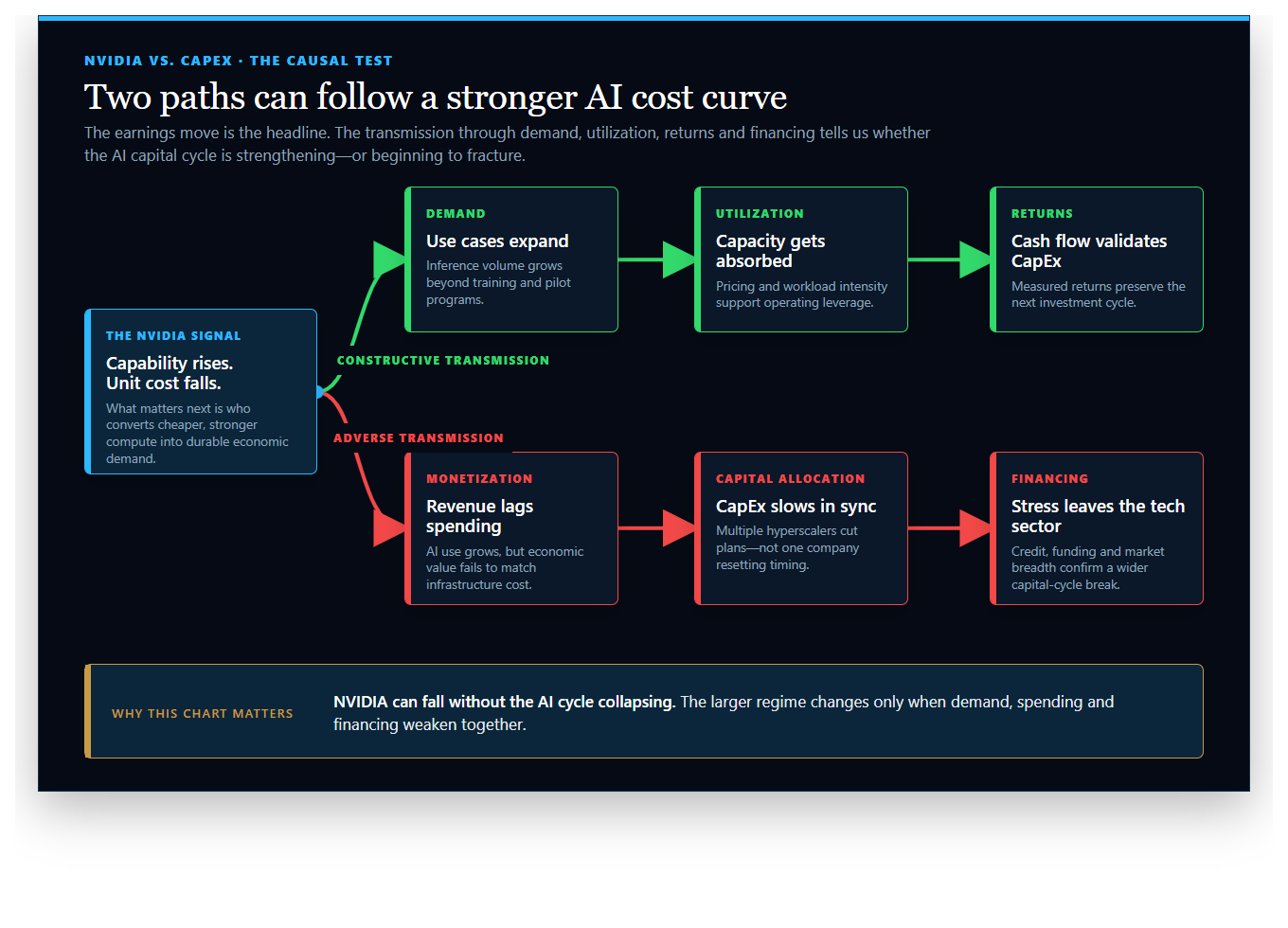
On the constructive path, model capability improves while the cost of useful output falls. Lower prices broaden adoption. More users and more complex workloads increase inference demand. Higher utilization supports revenue, and visible returns justify the next round of infrastructure spending. Better technology produces more demand, which finances still better technology.
On the adverse path, monetization lags behind depreciation, energy and financing costs. Several large buyers slow future capital spending at the same time. Suppliers reduce revenue expectations. Excess compute pressures rental prices and utilization. Assets designed for aggressive growth produce weaker returns while lease and debt obligations remain fixed. A technology correction then becomes a capital-cycle correction.
The same commitments that strengthen the constructive path can intensify the adverse one. That is why the market should watch the transmission mechanism, not simply NVIDIA’s headline earnings per share.
Later in this Insight, I use a seven-point scorecard to distinguish an ordinary NVIDIA valuation reaction from evidence that the broader AI capital cycle is strengthening—or beginning to weaken.
The transmission map
The framework below follows both paths from improving AI capability and falling unit costs through adoption, utilization, returns, capital spending and financing.
Continue reading
Read the complete Insight free during our beta.
Register for immediate access to the complete transmission map, the seven-point scorecard, the rest of this article, and other trial content. No credit card is required.
Register free and continue readingAlready registered? Sign in and return to the article.