
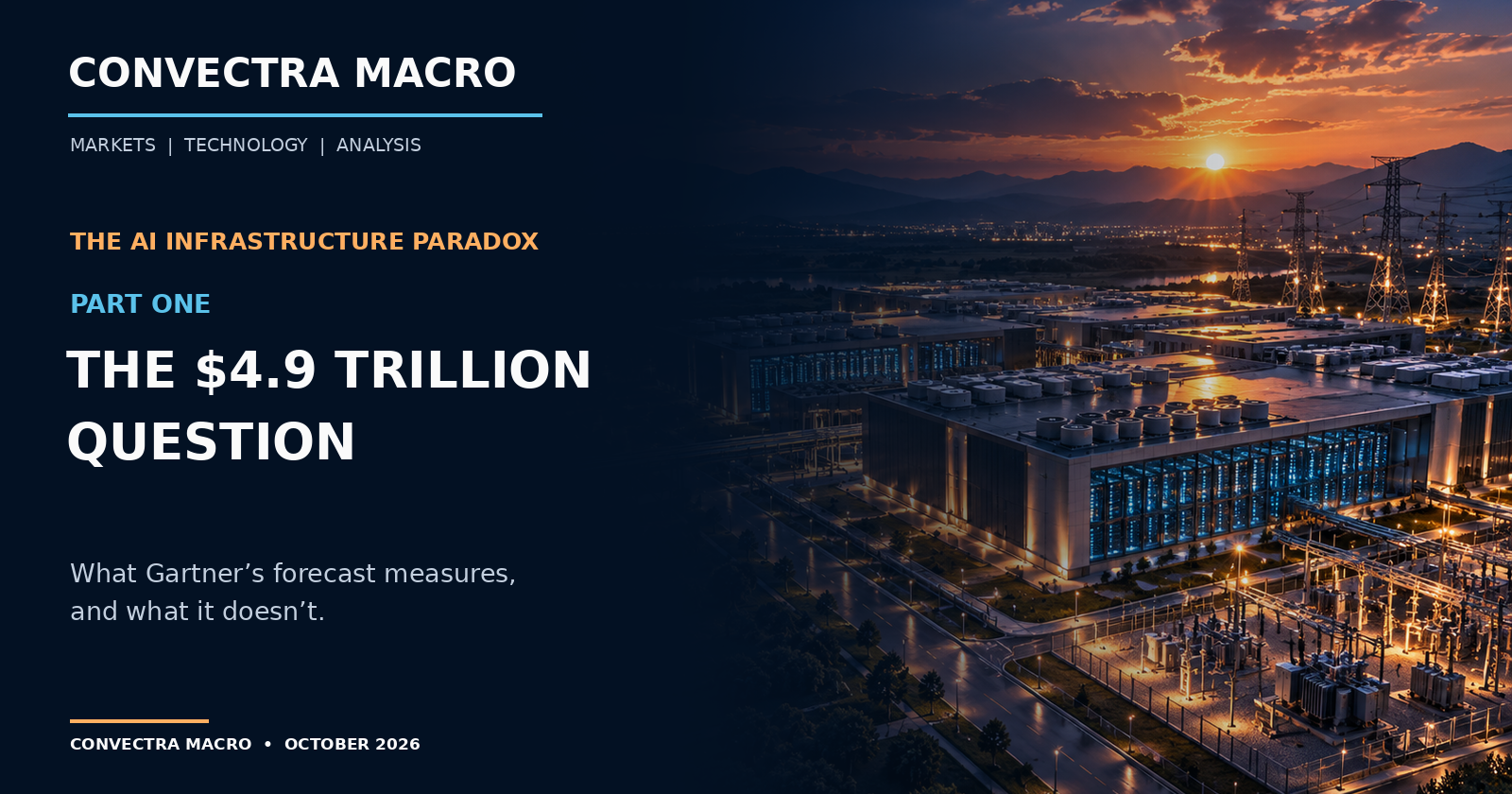
The AI Infrastructure Paradox — Part One of Two | Convectra Macro | October 16, 2026
When Gartner issued its October 14 warning about artificial intelligence infrastructure, one number drew immediate attention: $4.9 trillion. It is the difference between the $8.5 trillion in cumulative revenue Gartner estimates AI data-center owners would need through 2030 to cover announced investment, financing costs and a 12% return on invested capital, and the no more than $3.6 trillion in revenue Gartner expects could be attributed to AI data centers over the same period. [1]
The arithmetic is straightforward. The interpretation is not.
The $4.9 trillion difference does not automatically mean investors will realize $4.9 trillion in losses, or that $4.9 trillion of physical assets will become worthless. One figure is a modeled revenue requirement with a return hurdle built in; the other is an estimate of attributable industry revenue. We need to examine the assumptions before converting the gap into a prediction of financial destruction.
Gartner's warning deserves respect. Its same announcement says that more than $3.5 trillion of AI infrastructure spending could be exposed to impairment by 2030 if current investment trends persist, and that more than 80% of neocloud providers could cease independent operations by then. That is not a forecast that 80% of all data centers will close; consolidation can include acquisitions and reorganizations. These are high-stakes, conditional industry forecasts—not audited future results. [1]
First, distinguish a hurdle-rate shortfall from a cash loss
A project can disappoint investors without becoming unprofitable. If a business earns 8% on its invested capital when its financiers expected 12%, it has underperformed its target. That does not, by itself, prove its operating earnings or cash flow are negative.
And even a genuinely impaired investment may retain some economic value. In a distressed restructuring, original equity holders can lose money while a building, site and electrical system remain useful under new ownership.
The more important question is what Gartner's model counts: which entities earn revenue; which assets they own; when their cash flows occur; and how they measure residual value beyond 2030. The public press release does not provide enough model detail to independently reconcile all those elements. Gartner may already address them in its underlying research. Until the model is reviewed, claims that its math “ignores” infrastructure value go too far.
A data center is not a five-year GPU investment
A hyperscale AI campus has several layers of capital:
- Computing hardware: GPUs, other AI accelerators, servers, storage and fast networking. These face relatively rapid competitive obsolescence.
- Operational equipment: switchgear, UPS batteries, generators, pumps and cooling systems, often with different maintenance and replacement schedules.
- Physical infrastructure: buildings, substations, transmission and distribution connections, land improvements, fiber routes and security systems. Many components may remain useful for decades, subject to demand and retrofit requirements.
- Site-specific advantages: power availability, permitting, zoning, grid interconnection agreements, access to fiber and available space to expand.
It is wrong to depreciate all these economically distinct assets on one GPU replacement timetable. It is equally wrong to assume everything outside the server rack will remain commercially useful without further investment.
For illustration only, imagine a $10 billion campus allocated $6 billion to computing hardware, $3 billion to buildings, cooling and electrical systems, and $1 billion to land and site assets. Those shares are not measured industry averages; they simply reveal a valuation issue. If the IT equipment needs replacement in five years, that does not mean $10 billion has vanished. It does mean the operator must fund replacement hardware, potentially new cooling or power upgrades, while earning enough cash to justify the original investment.
There is a difference between accounting depreciation, economic useful life, and actual proceeds from selling a used asset. None is interchangeable with the other. An accounting asset may be fully depreciated yet still produce revenue; an expensive new GPU may remain physically functional but become uneconomic against newer equipment.
The importance of the power connection
Much of the AI discussion focuses on compute. But the ability to deliver and cool very large amounts of electricity is becoming strategically important. A campus with secured power, available grid capacity, cooling infrastructure and high-bandwidth connectivity may save a future tenant significant time and permitting risk versus building from scratch.
Those advantages must be valued realistically. A facility with no economically viable tenant, inadequate power density or costly cooling retrofits does not gain value simply because it is standing. Yet a well-positioned, powered campus could outlive multiple generations of servers—and may serve a different workload or tenant under different ownership.
This is also why landlord and operator economics must be separated. A data-center landlord can own the site, building and electrical systems while a tenant owns the GPUs. An integrated AI cloud operator may own both. The first primarily underwrites lease payments and tenant credit; the second takes direct hardware depreciation, utilization and compute-pricing risk.
One industrywide percentage cannot describe those risk profiles equally well.
What if the GPUs remain productive longer—or become obsolete faster?
We are treating hardware replacement as though the future were known. It isn't.
Training the largest AI models is one demanding use of accelerators, but not the only one. Older chips may continue performing inference for smaller models, data preparation, simulation or workloads optimized for their memory and energy profile. Quantization, distillation, compiler advances, caching and more efficient model architectures can change useful output per dollar of compute.
The reverse is possible too. A breakthrough in chip design or software could make old equipment less competitive faster than current forecasts assume. High-density racks may demand power and cooling changes that are expensive to retrofit.
The tempting example is quantum computing. It would be a mistake to say that quantum processors are about to do the “heavy lifting” for general AI models and automatically grant current GPUs two extra years. There is no sound evidence for that claim. Quantum processing is currently specialized; hybrid quantum-classical systems are a legitimate research area, but they do not constitute a demonstrated general replacement for GPU-heavy AI. AWS and its research collaborators have published a framework for when integrating quantum and classical compute helps particular workloads. [4]
What should the analysis do instead? Treat future architectures as scenarios, not as certain substitutes. A hybrid approach, photonic or application-specific accelerators, and faster software could extend some assets' lives, shorten others, or change which facilities are worth upgrading.
The correct financial test uses asset-by-asset life-cycle economics
To assess a campus, investors should map the cash flows by owner and asset category:
- Upfront cost and timing of land, construction, power connection, cooling and IT hardware.
- Annual revenue and operating costs for each tenant or compute offering, including utilization and power costs.
- Expected service lives and replacement capex for GPUs, networking and electrical/cooling equipment.
- Lease contract duration, tenant concentration and creditworthiness; refinancing exposure and cost of capital.
- Retrofit costs when chips, rack density or cooling requirements change.
- Remaining economic value at the forecast endpoint, including any recoverable terminal value, sale proceeds or continued operations.
- Downside cases in which utilization disappoints, tariffs/power costs change, or revenue fails to materialize.
The output should be a discounted-cash-flow estimate, sensitivity analysis and return-on-capital assessment—not simply gross revenue less a headline required-revenue number.
Crucially, this is not an argument that Gartner must be wrong. Gartner may be signaling a very real mismatch between capital intensity and the ability of infrastructure owners to capture economic value. Its release also estimates that less than half of attributable AI revenue will accrue to providers owning significant AI infrastructure, because many AI-native providers use asset-light models. [1] That revenue distribution could make the finances of infrastructure owners worse, even if AI applications grow rapidly.
The actual $4.9 trillion question
The question is not whether 8.5 minus 3.6 equals 4.9. It does. The question is whether that gap, on its own, tells us the eventual returns from a mix of buildings, land, power interconnections, cooling networks, and repeatedly refreshed hardware.
It does not. We need a longer life-cycle view and a clear allocation of revenue, investment and residual value. And we should expect different outcomes for hyperscalers, data-center landlords, neoclouds and AI application companies.
It is possible for an AI boom to transform productivity while disappointing—or even destroying—the returns of some of the investors who financed it. History has seen that distinction before.
Continue to Part Two: “The Infrastructure May Outlive the Investors”—railroads, Amazon and the possibility that enduring infrastructure matters long after the first financial cycle.
Sources
[1] Gartner, Oct. 14, 2026, “Gartner Says Over $3.5 Trillion of AI Infrastructure Spending Could Be Exposed to Impairment by the End of 2030.” https://gcomdr.pdo.aws.gartner.com/en/newsroom/press-releases/2026-10-14-gartner-says-over-us-dollars-three-and-a-half-trillion-of-artificial-intelligence-infrastructure-spending-could-be-exposed-to-impairment-by-the-end-of-2030
[4] AWS Quantum Technologies, July 20, 2026, “A framework for quantum-classical integration decisions.” https://aws.amazon.com/blogs/quantum-computing/a-framework-for-quantum-classical-integration-decisions/
Editorial note: This article is an independent interpretation of publicly available projections; it does not represent Gartner's endorsement or establish that its underlying detailed model omits long-lived asset value.
© 2026 Convectra Macro.
For general research and education only. This is not investment advice or a recommendation to buy or sell securities.
The AI Infrastructure Paradox
Read Part Two: The Infrastructure May Outlive the Investors →