
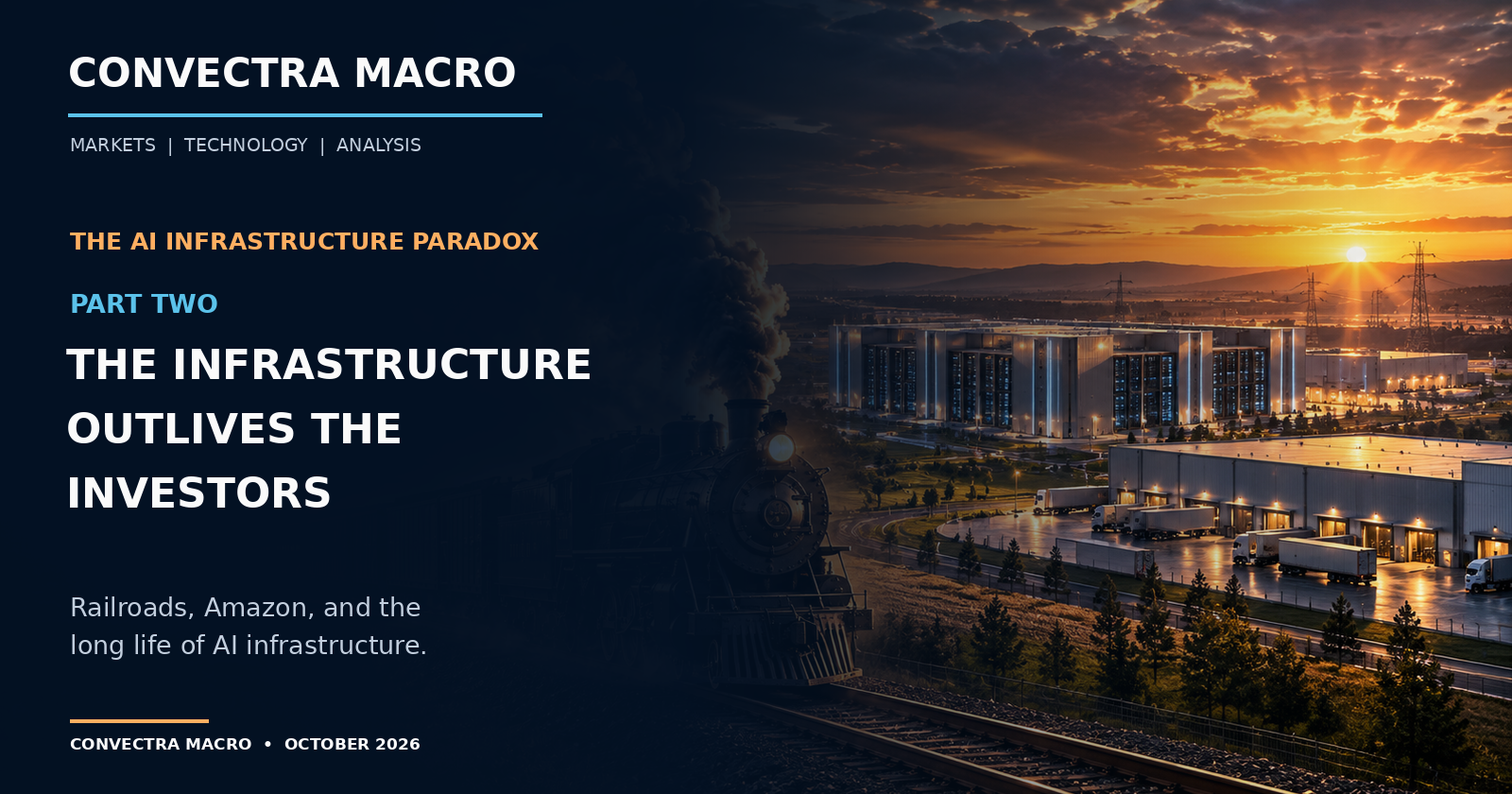
The AI Infrastructure Paradox — Part Two of Two | Convectra Macro | October 16, 2026
The financial history of technological revolutions has an inconvenient lesson: a breakthrough can change the economy without rewarding everyone who financed the breakthrough.
That possibility is at the center of today's AI data-center debate. Gartner estimates a $4.9 trillion gap through 2030 between its modeled revenue requirement for infrastructure owners and its projection of attributable AI revenue. [1] The warning is significant. Yet it raises a second question: what happens to the physical infrastructure if the first owners fail to earn their desired return?
Two very different American experiences—the nineteenth-century railroad boom and Amazon's decades of reinvestment—offer a way to think about it. Neither is a perfect prediction for AI. Together, they reveal why technology success, asset value and shareholder returns can move in different directions.
Railroads: financial failure did not erase physical utility
American railroads attracted enormous investment in track, bridges, locomotives, depots and rights-of-way. They connected farms, factories, ports and cities while lowering transport costs and opening markets.
But infrastructure demand was not unlimited at every price. Railroad promoters overestimated traffic, companies built competing routes, and many depended on continued access to debt markets. When financing dried up, investors faced bankruptcies, defaults and reorganizations.
The Federal Reserve's history of the Panic of 1873 specifically traces the crisis to railroad investment that outpaced demand for new capacity, weakening returns and exposing heavily financed companies when European investors pulled back. Railroad failures spilled into banks and the broader economy. [2]
The essential distinction: bankruptcy did not automatically make the tracks, bridges or transportation corridors unusable. Productive assets could be sold or reorganized, and operating networks continued under new owners. There were exceptions—redundant lines and badly located assets could also be abandoned. The mere existence of a rail bed did not guarantee value.
Imagine an AI campus with high debt service costs and insufficient near-term computing revenue. The developer might fail, and its equity investors might lose most of their capital. Yet a financially stronger buyer could acquire the powered site at a lower cost and use it profitably. The technological infrastructure could succeed across generations even if the initial investment did not.
That is not an excuse for paying too much. It is a reason to distinguish the price paid by the original investor from the intrinsic and transferable value of the surviving asset.
Amazon: infrastructure as a platform, not simply an expense
Amazon suggests a different model. For much of its history, the company chose reinvestment over maximizing reported earnings. It built fulfillment centers, transportation systems, software platforms, seller services and massive operational capabilities. That infrastructure helped Amazon add categories, serve more customers and offer logistics capabilities that smaller rivals struggled to replicate.
Amazon Web Services then turned large-scale computing expertise into a separate business with substantial revenue and profit. Amazon's 2025 annual filing reports $139.5 billion in cash from operating activities and $128.3 billion in property-and-equipment purchases, net of sales proceeds and incentives, much of the investment directed toward technology infrastructure supporting AWS and additional fulfillment capacity. [3]
But the usual shorthand—“Amazon lost money for decades, then won”—is inaccurate. Amazon did not report losses every year; it generated meaningful operating cash flow while repeatedly reinvesting. It also developed customer relationships, software, execution capabilities and demand. Infrastructure alone was not sufficient.
The powerful insight is narrower: infrastructure can create strategic options that were not fully obvious at the time of construction. A fulfillment network built for retail becomes a platform for third-party sellers and new services; a cloud platform becomes a foundation for countless business applications.
Could an AI campus built for model training in 2026 support different forms of computing in 2036? Possibly. A powered, networked campus could serve inference, enterprise cloud, scientific computing, simulation or applications we cannot now name. But adaptive reuse depends on energy economics, contracts, equipment configuration and retrofit cost.
AI could combine the Amazon and railroad outcomes
Suppose the current expansion produces more compute capacity than the near-term market can profitably absorb. Financial distress could lead to write-downs or consolidation, particularly among leveraged neocloud providers.
At the same time, high-quality land, substations, connected megawatts, cooling plants, security infrastructure and fiber networks could remain useful. New owners might operate the same real estate at a lower capital basis. Others might transform it for different tenants or computing architectures.
Conversely, some of today's strongest hyperscalers might resemble Amazon's long-term reinvestment story. They have mature businesses, established customers and significant financial resources. But even they can overspend, misjudge future demand or fail to earn their cost of capital on specific projects.
This is why “AI is real” and “some AI infrastructure investors will lose money” are not contradictory statements.
Which assets survive the compute cycle?
A data center has more than one economic clock. A GPU may become uneconomic for frontier training much earlier than the building it occupies. Cooling systems, power distribution, networking and batteries all have their own replacement patterns. Land and site rights have still another economic profile.
There is also the power premium: obtaining an adequate grid connection may require considerable time and capital. A site with dependable electrical access may become more attractive as the number of data-hungry applications rises.
But a data center cannot simply be “amortized” as one homogeneous block of spending. In technical accounting, buildings and equipment are generally depreciated, not amortized; financing or intangible assets can have different treatments. In finance, the entire project must be evaluated by life-cycle cash flows, considering the useful lives of separate assets, refresh costs and any remaining sale or operating value.
The strongest financial analysis would distinguish at least three businesses:
- The infrastructure landlord, whose economics depend on rents, tenancy, power capacity, long-duration contracts and operating costs.
- The compute operator, whose economics depend on GPU utilization, selling prices, power bills, equipment refresh cycles and financing.
- The application provider, whose economics depend on how much value customers will pay for AI and how much of that value flows back to infrastructure providers.
Confusing their revenue and capital requirements creates misleading industrywide conclusions.
What quantum—and other technologies—might change
A provocative idea follows: what if the next computing advance extends rather than destroys the usefulness of today's GPU fleet?
Model compression, quantization, better scheduling and specialized software can make existing hardware more productive for some workloads. New AI chips might offload specialized tasks while conventional accelerators continue to run other parts of a system.
Quantum-classical hybrid computing is under active investigation. AWS and collaborators described how quantum and classical processors might interact for selected high-performance computing workloads. [4] This is evidence of research, not evidence that quantum computers will soon replace AI training GPUs, run general-purpose LLM inference, or extend GPU depreciation schedules by two years. Today, that would be speculation.
And technology may have the opposite effect: cheaper, more capable accelerators could reduce the market price of older compute; denser racks may require electrical and cooling renovations. Therefore, hardware life should be tested under upside, base and downside scenarios, not predicted with false precision.
Four outcomes investors should model
The Amazon case: demand, efficiency and new applications grow enough that major operators earn good returns on sustained reinvestment. A first mover's customer ecosystem may matter as much as the physical plant.
The railroad case: building occurs too early or at too high a capital cost. Some operators fail, but quality infrastructure continues to generate value after recapitalization or acquisition.
The technology-transition case: new architectures change the division of work between GPUs and other processors. Adaptable campuses gain optionality; some equipment lasts longer and some becomes obsolete faster.
The overbuilding case: uneconomic locations, weak tenant demand and high retrofit costs leave parts of the buildout stranded. Power access and buildings alone cannot rescue every project.
These scenarios are not mutually exclusive. Large diversified companies, specialist landlords and debt-funded neoclouds could land in different categories at the same time.
The real question is not how much is being spent—but what survives
Gartner's analysis performs a valuable service by forcing investors to compare the capital committed with the revenue that infrastructure owners can realistically capture. [1] Its headline numbers also deserve careful interpretation: $4.9 trillion is a modeled revenue shortfall against a financing-and-return hurdle, not a measured loss.
Railroads show that lasting infrastructure can outlive its original investors. Amazon shows that well-executed, long-duration reinvestment can create businesses that were not evident at the start. Neither proves the current AI buildout is appropriately priced.
The ultimate test is whether the present value of cash flow, after paying for future equipment upgrades, plus a defensible residual value exceeds the complete capital cost. That calculation must be made for the specific assets and owners, not by treating GPUs, buildings and land as if they all expire in the same year.
AI could change the economy while leaving behind both winners and bankruptcies. A data center might remain valuable long after its first fleet of processors is replaced. Or poor siting, overbuilding and unexpected technology shifts could make it far less valuable than hoped.
The infrastructure may outlive the investors. The important question is who eventually owns it, what they paid for it, and whether its future cash flows justify that price.
Read Part One: “The $4.9 Trillion Question” for the detailed examination of Gartner's forecast, GPU obsolescence and asset-by-asset valuation.
Sources
[1] Gartner, Oct. 14, 2026, AI infrastructure impairment warning. https://gcomdr.pdo.aws.gartner.com/en/newsroom/press-releases/2026-10-14-gartner-says-over-us-dollars-three-and-a-half-trillion-of-artificial-intelligence-infrastructure-spending-could-be-exposed-to-impairment-by-the-end-of-2030
[2] Federal Reserve History, “Banking Panics of the Gilded Age.” https://www.federalreservehistory.org/essays/banking-panics-of-the-gilded-age
[3] Amazon.com, 2025 Form 10-K, SEC filing (cash flow and cash capital expenditure disclosures). https://www.sec.gov/Archives/edgar/data/1018724/000101872426000004/amzn-20251231.htm
[4] AWS Quantum Technologies, July 20, 2026, “A framework for quantum-classical integration decisions.” https://aws.amazon.com/blogs/quantum-computing/a-framework-for-quantum-classical-integration-decisions/
Editorial note: Historical analogies are interpretive; a data-center site's continued usefulness does not imply original equity investors avoid losses or that every site retains value.
© 2026 Convectra Macro.
For general research and education only. This is not investment advice or a recommendation to buy or sell securities.